
As the longest night of the year approaches, witches and nature-based practitioners prepare to celebrate…
Origins of the Summer Solstice
The Summer Solstice—the longest day of the year, when the sun appears at its highest point in the sky—has been a central festival across countless cultures. For modern pagans, it is often called Litha, Midsummer, or simply the Solstice, and it holds a place of profound honor as a celebration of life, abundance, and the sacred cycles of nature. To understand why it is so enduringly significant, one must look to its ancient pagan roots, its associations with gods, fertility, fire, and harvest, and the ways communities have honored the sun’s power for thousands of years.
Cosmic and Astronomical Significance
The solstice marks the turning point in the solar year, occurring when the Earth’s axial tilt is most inclined toward the sun in the Northern Hemisphere. This astronomical event typically falls around June 20–22. Ancient peoples were deeply aware of the sun’s patterns, using them not only for agricultural calendars but also for religious and spiritual symbolism.
Monuments like Stonehenge in England and Newgrange in Ireland were aligned to the solstices, demonstrating how central the solar cycle was to ritual life. These structures were not only observatories but sacred sites where people gathered to celebrate the sun’s peak power. The light of the solstice sunrise streaming directly into such temples was a symbolic marriage of earth and sky, of human community and cosmic order.
Pagan Mythology of the Sun
The Sun as a Deity
In pagan traditions, the sun is more than a source of heat—it is a divine being. In Norse mythology, the sun was personified as Sól, a goddess who drove the sun’s chariot across the sky. Among the Celts, the sun was often linked with life-giving goddesses such as Áine, associated with fertility and sovereignty.
In ancient Greece, the sun god was Helios, later associated with Apollo, who represented light, truth, and prophecy. Similarly, in Rome, the solstice was connected to Sol Invictus, the “Unconquered Sun,” celebrated as a force that could not be dimmed even by the turning seasons.
The Oak King and Holly King
In modern Wicca and other pagan traditions, the solstice is dramatized as a mythic battle between the Oak King and the Holly King. The Oak King, ruler of the waxing year, reaches his peak at midsummer, only to be defeated by his twin and opposite, the Holly King, who rules the waning half of the year. This duality symbolizes the eternal cycle of growth and decline, light and dark, death and rebirth.
Fertility and Fire Rituals
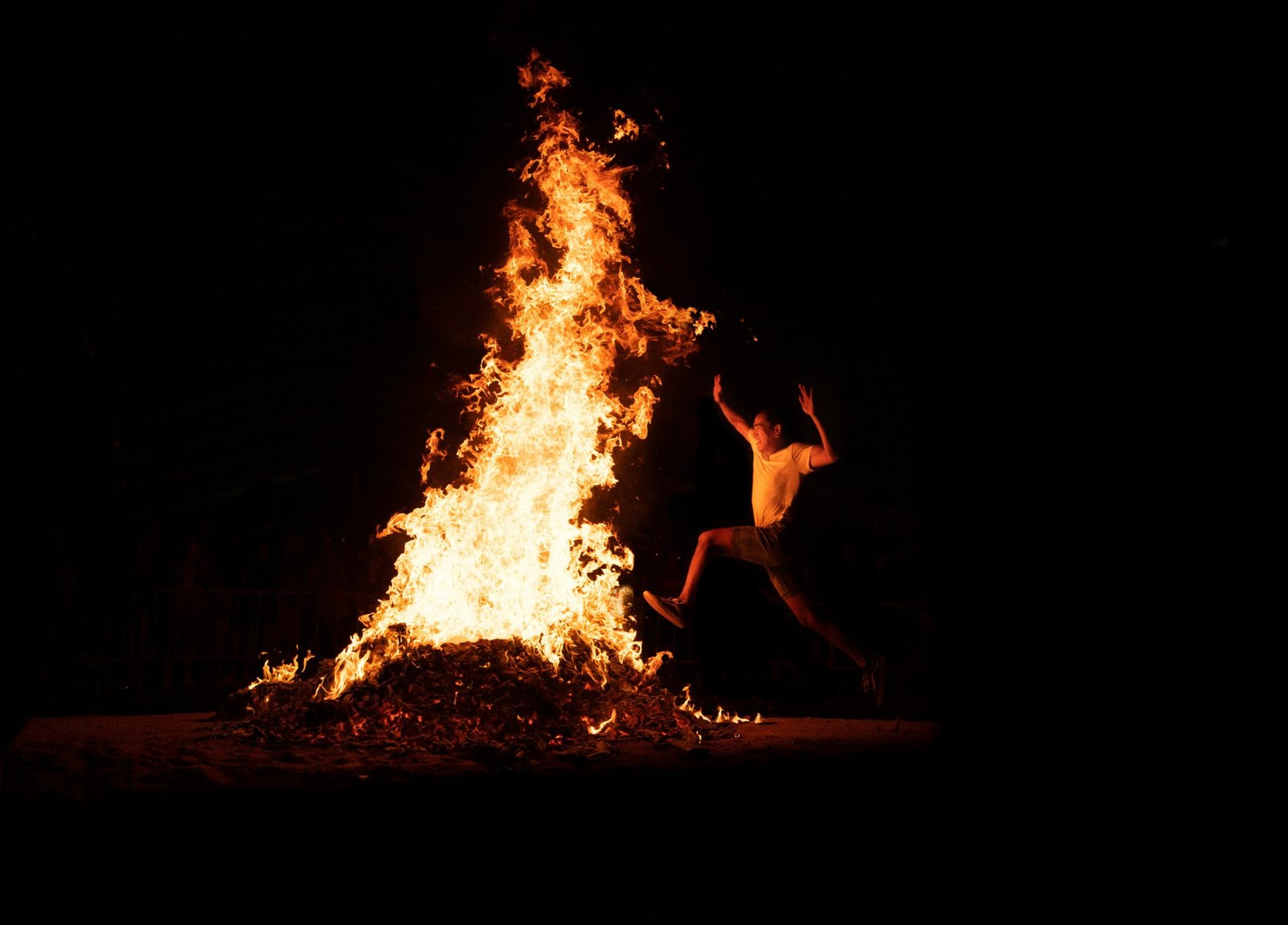
Across pagan Europe, the summer solstice was celebrated with bonfires. The fire symbolized the sun’s power and was believed to protect against harmful spirits, encourage fertility in the fields, and bless communities. People leapt over the flames, danced around them, or drove livestock through smoke for purification.
In the Slavic world, Kupala Night was held near the solstice, combining fire, water, and fertility rites. Couples would jump over bonfires to test their love, and maidens floated flower wreaths on rivers to divine their romantic futures.
The Celts also lit great fires on hilltops, a tradition remembered in modern Beltane and Midsummer celebrations. These fires honored the sun’s abundance, strengthening its power as it began its slow decline after the solstice.
Agricultural and Community Importance
For agrarian societies, the solstice aligned with the ripening of crops and the promise of the first harvests. Communities gathered to honor earth’s fertility, to thank the sun for its gifts, and to petition for continued abundance. The link between sun, crops, and human survival was sacred.
The Norse peoples celebrated Midsummer, weaving it into their seasonal cycles of planting, tending, and harvesting. The Celts connected midsummer with the Green Man, a symbol of growth and the eternal cycle of vegetation.
These rituals were as much about community bonding as they were about religion. Gathering at sacred sites, feasting, dancing, and storytelling helped maintain cohesion and a sense of belonging, reinforcing cultural identity through shared celebration of cosmic order.
Pagan Roots in European Traditions
The Summer Solstice was absorbed into later Christian festivals, most notably St. John’s Day on June 24, which inherited many fire customs. Yet the pagan substratum remained visible, surfacing in place-names, folk songs, and seasonal rites that were too deeply woven into local life to disappear.
In the Baltic region, Jāņi is still celebrated with bonfires, feasting, and wreath-wearing. In Scandinavian countries, maypoles—though more associated with May Day—are also used in midsummer to honor fertility. Herbs gathered on midsummer were believed to be especially potent, tied to the sun’s blessing and the liminal power of the turning year.
Such survivals show the resilience of pagan cosmology. Even where official doctrine discouraged older practices, communities reinterpreted rather than abandoned them, integrating solar rites into a new religious framework while retaining the seasonal heart of the older ways.
Modern Pagan and Wiccan Celebration
Modern pagans, especially those working within the Wheel of the Year, honor the solstice as Litha. Rituals often include sunrise ceremonies, greeting the dawn at hilltops or shorelines, followed by feasting and communal gatherings. Many practitioners create altars adorned with sun wheels, candles, and summer herbs, and they offer libations to deities of light and fertility.
Continuing fire traditions of old, practitioners light bonfires or candles to mark the sun’s zenith. Some gather herbs like St. John’s Wort, which folklore holds to be especially powerful at this time, and craft wreaths of protective plants to hang on doorways. Others focus on healing and gratitude rites, celebrating the body, the land, and the community that sustains them.
Many see this as a time of personal empowerment, harnessing the sun’s strength to fuel inner growth. Spellwork may center on prosperity, protection, or clarity of purpose. The aesthetic of the season—bright colors, sun disks, honeyed mead, and fresh fruits—becomes a lived theology, a way of expressing reverence for the world’s abundance.
Symbolism of Light and Dark
One of the most profound aspects of the solstice is its paradoxical nature: even as the sun reaches its highest point, the days begin to shorten. Pagan traditions emphasize this duality—life is strongest at the very moment it begins to wane. This mirrors human existence: moments of triumph are always interwoven with change and eventual decline.
For pagans, the solstice teaches acceptance of cyclical time. Unlike the linear, progress-driven view of history, the seasonal cycle reminds practitioners that life, death, and rebirth are endlessly interwoven. The solstice becomes a ritual meditation on the balance of opposites, the union of sun and shadow, the celebration of fullness with an awareness of transience.
This awareness informs ethical practice as well as ritual. Gratitude becomes a discipline; generosity a response to abundance. The solstice asks celebrants to savor, to share, and to steward—recognizing that what is plentiful today must be cared for to endure tomorrow.
Why Pagans Continue to Celebrate
The summer solstice remains a living tradition because it honors the Earth’s rhythms with immediacy and joy. It affirms that spirituality can be embodied—felt on the skin as sunlight, tasted as ripe fruit, heard in communal song around a fire. The day invites celebrants to experience holiness not as an abstraction but as the very texture of the season.
It also maintains continuity with ancient ancestors. To track the sunrise as it clears a ridge, to weave flowers into a wreath, to leap a flame for luck—these are bridges across time. In them, practitioners feel the presence of those who stood under the same sun and asked for the same blessings of health, love, and good harvest.
Finally, the solstice practice inspires ecological mindfulness. By honoring the sun and the thriving world it sustains, pagans reaffirm commitments to sustainable living, local foodways, and protection of wild places. The festival’s heart is relational: to the land, to community, and to the more-than-human world that shares the season’s abundance.
The Summer Solstice has always been more than an astronomical event. It is a pagan celebration of life, a recognition of the sun’s life-giving force, and a reminder that abundance and decline are part of the same cycle. From the firelit hills of ancient Celts to the sacred alignments of Stonehenge, from Norse midsummer revels to modern Wiccan circles, the solstice weaves a thread through human history.
Its symbols—bonfire and flower, sun wheel and wreath, sunrise and shared meal—continue to resonate. By celebrating at the moment of greatest light, pagans acknowledge the wholeness of the cycle: ascent and descent, fullness and release. The solstice invites us to honor vitality without clinging, to give thanks without forgetting the work of tending, and to find our place in the vast choreography of earth and sky.

Related Posts


Comments (0)